

“The art that is being made by people who are engaging with AI, it’s almost becoming a different strand of art.” Artist Geoff Langan, has worked has fallen in and out of love with photography over the years and now has a new romance that combines taking photos and using artificial intelligence to alter them and explore new worlds.
by Jamillah Knowles
Geoff Langan strove for a career in photography. In his 20s he studied, learned by assisting professionals to create still life commercial images and then started out on his own, capturing portraits and taking photos of people who were considered, a couple of decades ago, to be on the fringes of society.
“The first feature I did for Marie Claire was ‘transvestites and their wives’,” he says. “Now, few people would blink an eye at the topic, or things like women in boxing. It was all very different then when I was working for magazines and weekend supplements.”
Sadly what was a career and a passion petered out, “After a long relationship, photography fell out of love with me, ditched me and said it didn’t need me anymore,” Geoff explains. “I say that flippantly, but it really hurt at the time. I was trying to reinvent myself. I had the pressure of being a new husband and a new father, trying to make it work, and get paid.
This was all being affected by the digital revolution. In the end, I hated it.”
Geoff was working in a time where digital cameras were becoming more accessible to photographers in terms of price and range, and digital libraries were emerging from visual media companies like Getty Images. Traditional photography was hit hard for those who were not willing or able to invest in the new technologies.
Geoff made a complete break. He studied to be a counsellor after volunteering at a residential rehabilitation centre. “I went over and offered to work and they offered me a job,” he says. “It was £7.20 an hour and I did a quick calculation and realised I would be rich in comparison with being a photographer. So I became a support worker at a residential rehab and I loved the work.”
It was while Geoff was training to counsel people living with addiction issues that he realised that he had a problem too. “I saw no problem with going home and drinking about half a dozen cans at midnight and toddling off the bed. I did my two-year diploma with UWE and I bargained with myself. It was only one night a week and I wouldn’t drink before college and then there was supervision and times when we started to give counselling to people, so that became three nights per week. I remember wondering what I was hanging on to. It was a time to change and we went on a camping holiday and I stopped, I had broken that pattern. That was about 17 years ago.”
After spending ten years working with people to cope with gambling, alcohol and drug addiction, Geoff became disillusioned. The work is hard and people need to invest in themselves for change. When this was not forthcoming, he found the work frustrating and decided to stop.
From here he stepped back into visual arts, doing 360 degree VR tours with a friend. “We used a Matterport camera which you put in the centre of a room and it spins around to create a digital twin of the space you are in and people can look at it and move around in that space. We were then asked to do still photography and this reignited the spark.”
Geoff’s main focus was not the buildings and homes he was making 360 virtual tours of, but utilities, under-appreciated necessities of life. “I spent a year working at the Bristol Port taking photos of buildings and structures, machines – anything that wasn’t human there,” he says. “On Instagram at the time people had great pictures of mountains at dawn, beautiful beaches. That’s not my world. My world is the local petrol station, supermarkets, things like that and I wanted to give them that same Instagram effect. I wanted to pay homage to the places that really mean something to people every day.”
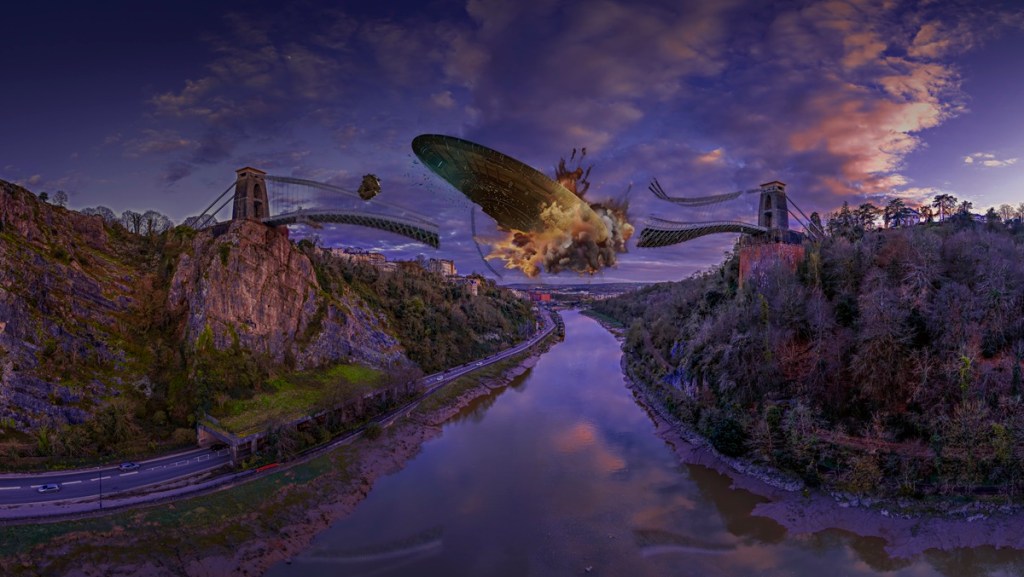
This was the gateway back into image making, but Geoff is not one to stand still and he has an ongoing interest in what’s ahead and what’s new. In this case, it was artificial intelligence and the arrival of accessible generative AI programs that could turn text prompts into pictures. While he found it intriguing, he initially struggled to work out how to add it to his own workflow. Strangely, the answer came possibly from a galaxy far, far away.
“I had been listening to podcasts about UFOs,” he says. “If you look for pictures of UFOs, they are a little grainy shape in a white sky. I decided to make little grainy images in my photos as a bit of a joke, almost unnoticeable. Then I decided to go the other route, shoot a beautiful cityscape and put an incredible AI generated UFO in there, so there’s no question that it’s there.”
Though generative AI is clearly having an impact on the creative arts, Geoff feels hopeful. “There are things that AI can do,” he says, “Like product design, maybe product photography and other things that might sweep the board when it comes to working those jobs, but that doesn’t mean that photography is going away any more than vinyl did. The pound will decide what goes and what doesn’t.
“If we are talking about art, it has different parameters. People look for different things. It’s too early to tell what the outcome will be. The art that is being made by people who are engaging with AI, it’s almost becoming a different strand of art, it’s becoming something else. Not better, just different. People take time to adjust.”
See more of Geoff’s work on Instagram at @geofflanganphoto
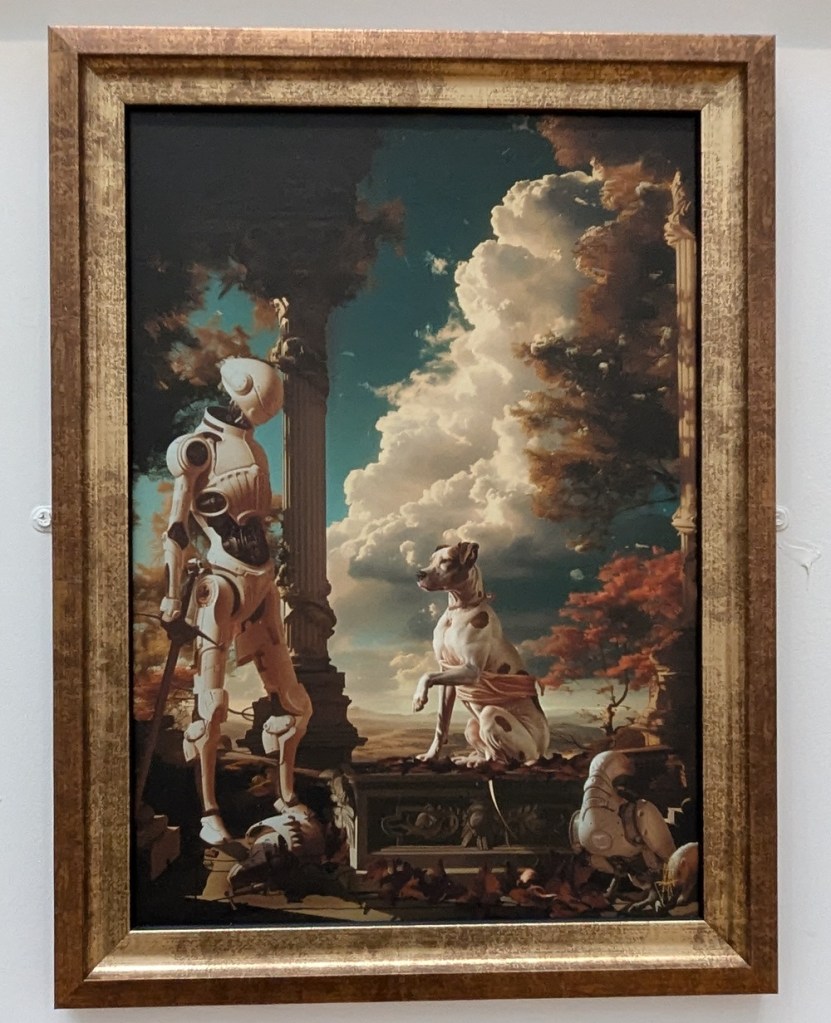
Read Jamillah’s article An obedient dog? AI, art and the RWA here.
Jamillah Knowles is a writer, artist, AI specialist and RWA Friend. You can read a Floating Circle Meet the Artist Q&A with her here.

 The Floating Circle