
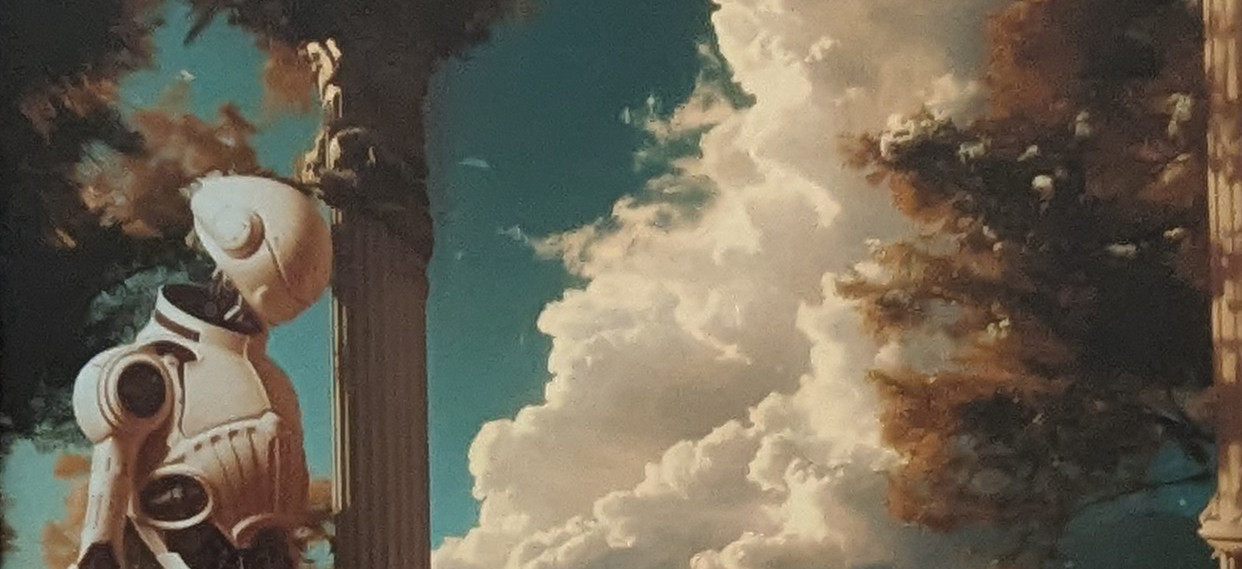
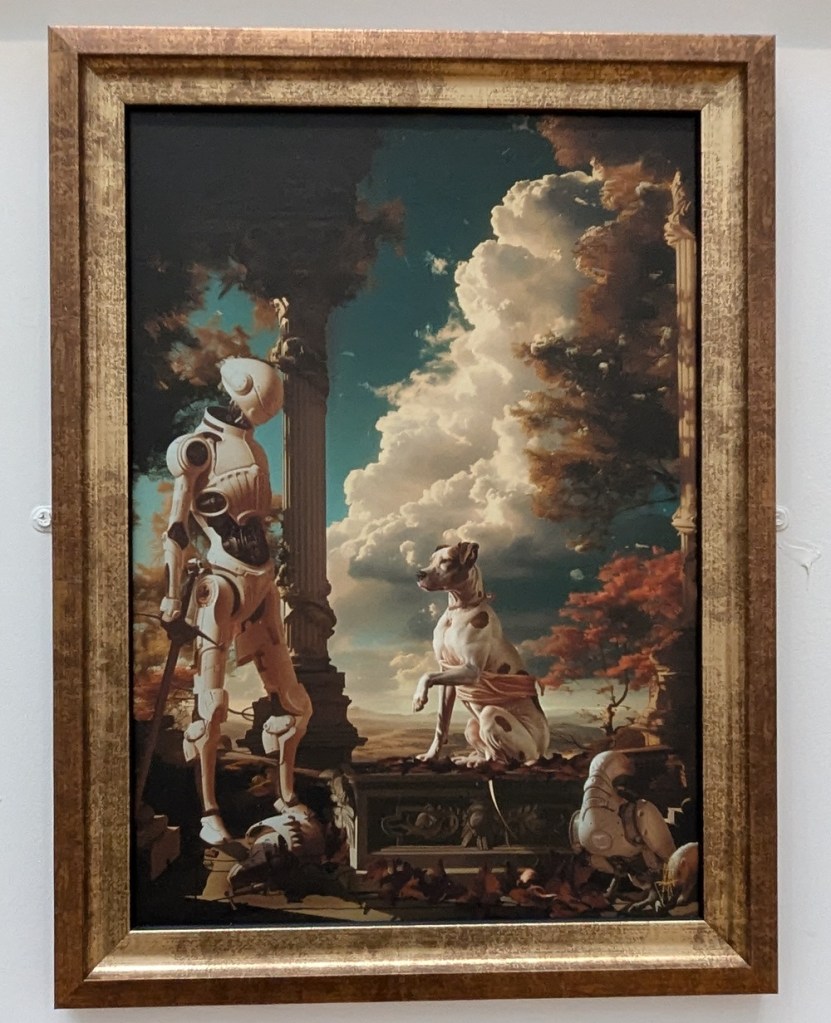
AI is having an increasingly significant – and controversial – impact on many areas of life, and art is no exception. This year’s RWA Open included an AI-generated work ‘Obediens Canis’ by artist Geoff Langan, prompting much discussion.
Here, Jamillah Knowles looks at issues surrounding AI and the art world – and how the RWA is responding to them…
It’s a sunny autumn day in Bristol, the roads are shining and slick from a morning rain shower, leaves are scattered on the ground and there’s an AI-generated piece in the RWA Open exhibition. The start of this list is not expected for this time of year, but for some, an AI piece in a Royal Academy Open is something very new.
A couple of years ago, trustee and academician Hamish Young noted that there was a need to address AI artwork. In 2022, powerful programs like Midjourney were offering people ways to create images by inputting text prompts to return dream-like and slightly surreal pictures. With a technical resource like this, it was clear that artists would be paying attention and getting to know the tools that could make great changes to their work. Those tools are now capable of making more accurate and impressive pictures that are being used in many of the creative industries.
To address the idea of allowing AI images into the Open exhibitions, an expert panel was gathered to discuss the pros and cons. The group thrashed the ideas around, discussing things like authorship and intellectual property, processes and expert skills and came to the conclusion that yes, AI generated content could be a part of an artist’s processes for works entered into the Open this year.
Professor Shawn Sobers of UWE Bristol led the team through their concerns and ideas, “I wanted a round table of staff, students and artists who all have different views and experiences of AI so we could have a complex conversation about AI. The panel came to the idea that if art is something that moves you, and you have an emotional response, then does that elevate it to being art? We realised that if there was an outright ban, artists would find ways to circumvent that ban. So we discussed having an option on the submission of works where artists could highlight their use of AI tools along with other options like materials or processes used. It shows that the RWA is interested in AI processes among many other methods of making art.”
The panel also put forward the idea that it should not be mentioned to judges how images were made so that they can make their decisions based on their response only to what they are seeing and not whether AI technologies were used. “If they want to accept a work of art because it moves them, then that should be it. If it needs a second round of discussion and judgement then experts could be brought in,” Shawn says.
Whether or not a piece of art has been made entirely with AI or by using AI tools can influence our response to what we are seeing. Ming Tsai, now a PhD student in Newcastle was studying for her Masters Degree at UWE Bristol and took part in the expert panel. Her own work, strikingly beautiful oil paintings influenced by vaporwave aesthetics and internet art delicately balances the value of humanity in painting while representing our digital lives. “I admit that when I see a work of art and I might like it, I like it a bit less when I find out that it was made only using AI,” she says.
“We have to find a way to live with new technologies,” she continues. “We need to be clear about how these technologies are being used in art and it’s exciting that the Academy is open to including this sort of art. I have friends who use AI tools to create cool images. It’s great to reflect this age and show people it’s not just a tool, it’s sometimes a new friend for thinking about art and ideas.”
“Having AI work accepted can challenge the notion of Open exhibitions,” says Shawn. “There have probably been clauses added before when creative technologies emerge. Photography had people up in arms in the past and these events will continue to evolve.”
Nuance not polarisation
Two main points of risk were raised in that meeting. One was around the openness of the Open Exhibition and transparency of processes by artists. Given boundaries to thrash against, many artists will try to work out loopholes of creativity, it’s part of an artists’ remit to experiment, learn and test the boundaries of what can be done. With that in mind, to block the application of artists using AI would likely mean that some artists would be using it anyway and just not declare it on entry. Worse still, they could put forward an AI-generated piece and then create headlines of a ‘gotcha’ nature, having fooled an institution.
The categorisation of works that use AI in their creation was another point for clarification. For now, AI generated works are filed under ‘digital’. “It’s not a defined genre yet,” says Hamish. “It’s not photography, it’s not collage and it hasn’t quite emerged as its own genre. It’s possible that this will change over time but for now we consider it to be digital art.
“Part of that decision is to allow the judging panel to have autonomy over their decision-making,” he continues. “Not all AI art is entirely AI generated and the hand of the author appears at various stages of a work. This can’t always be clearly outlined and when our judging panel comes to a piece for the Open, they have to be able to make a decision based on their assessment of the work as it is presented to them.”
Another thorny issue is that of IP. It has been an incendiary point among artists online. Tech companies that have brought generative AI tools to consumers often scrape the web for data – meaning that there will be some intellectual property in those tools that artists are not being paid for. There are ways that artists can use their own images and data to inform AI programs that don’t use data scraped from the web though and this option.
For the RWA Open, the terms and conditions say that the work must be the artist’s own. This puts the onus on the artist to act well – and if their work turns out otherwise – just like with plagiarism, it would be removed. Like a lot of legislation around AI in other industries, it makes sense to lean on existing guidance and rules to form the next steps. Plagiarism would not be encouraged in the open, nor would stolen IP of any other kind and that comes down to the artists’ choices.
For clarity, here’s the wording for the RWA open applications –
The section that is relevant in included in the Paper Works Open:
Section 15: Copyright
- Copyright remains with the artist; however, by registering online and agreeing to the terms and conditions the artist agrees that their work can be used for the promotion of the RWA and its exhibitions.
- If an artist does not own all of the rights, title and interest in and to a Work, the RWA must be expressly informed in writing of all relevant details concerning all other third parties’ rights to that Work. The artist shall indemnify the RWA against all losses, liabilities, costs and expenses in respect of claims made by third parties alleging partial or total ownership of the Work or any rights in the Work, including intellectual property rights.
“By neither excluding or promoting AI-generated work in the Open, the RWA is enabling artists to explore new ways of working,” Hamish explains. It also encourages artists to be transparent about their work and the sources they may use rather than trying to sneak it by a judging panel.
How the work was made
Geoff Langan is the artist who made the image in the show using tools including Midjourney, Photoshop, Lightroom and TopazLabs shared the experience of creating with AI. He has a strong background as a photographer for some of the world’s top magazines but fell out of love with the medium until he started to experiment with new technologies the familiar subjects like local petrol stations, boats out of water, kebab shops and supermarkets where he could give them the glamorous ‘Instagram’ treatment which is usually applied to sunsets and expensive breakfast meals.
Geoff’s work with AI in image making came from an unlikely source. “I’ve always been interested in what’s new and what’s next,” he says. I tried working with Dall-e and I liked it but I wasn’t finding a way to use it. My introduction to really using AI came about in an entirely different way. I was listening to podcasts about UFOs and when you look for images of UFOs, they’re grainy pictures of a dot in the sky, so I thought I would do something with a grainy picture and add a UFO in there. Then I went the other way and created a beautiful cityscape and put an incredible and detailed UFO in there. I had finally found something I could use text to image AI for and I used Midjourney to create images.
The use of AI could appear anywhere in an artists’ journey should they choose it. It could be a prompt or line from an essay or other works that sparks a chain of thought that could be pursued in any medium. “I have used AI with photographs that I take on my iPhone, often with a panoramic tool and then deciding what would be interesting to put in there. I took some images of a stately home and decided to put whirling dervishes in there. As a traditional photographer I would have to get models, stylists and actors. It would be a large production to get there, but I use that thinking to approach Midjourney to prompt and adapt what I am asking the technology to do in order to create the images together. It’s not just servicing my needs like Photoshop, it’s like asking the machine what it thinks my prompts should look like and now I have this dialogue going on with technology. I can add Midjourney images to my photographs to tell a different story.”
Geoff’s image in the RWA Open right now is a clear exercise in storytelling. “It shows a picture of a dog and a robot,” he says, “which is about showing where we are now with the dog as humanity and the cyborg figure with a sword which represents the future of AI. It’s a benevolent figure and it does hold a sword, so it has potential to do us harm, and the dialogue it is intended to show is that we can work together. The dog doesn’t have to use its teeth and the robot doesn’t need that sword.” The placement of the figures are set in an old style scene with Greek columns and motifs, describing a contrast between history and a possible future.
It’s entirely possible that AI works have been submitted to the Open before without being declared. By establishing the beginnings of working with AI for exhibitions like this, the RWA is actively engaging with the use of artificial intelligence. While the rules are not set in stone these technologies will evolve and society and culture will change to work with them, it’s likely that the way we see AI generated art presented in exhibitions will be updated to fit with times that seem to be changing very quickly.
Jamillah Knowles is a writer, artist, AI specialist and RWA Friend. You can read a Floating Circle Meet the Artist Q&A with her here.

 The Floating Circle
1 Comment