
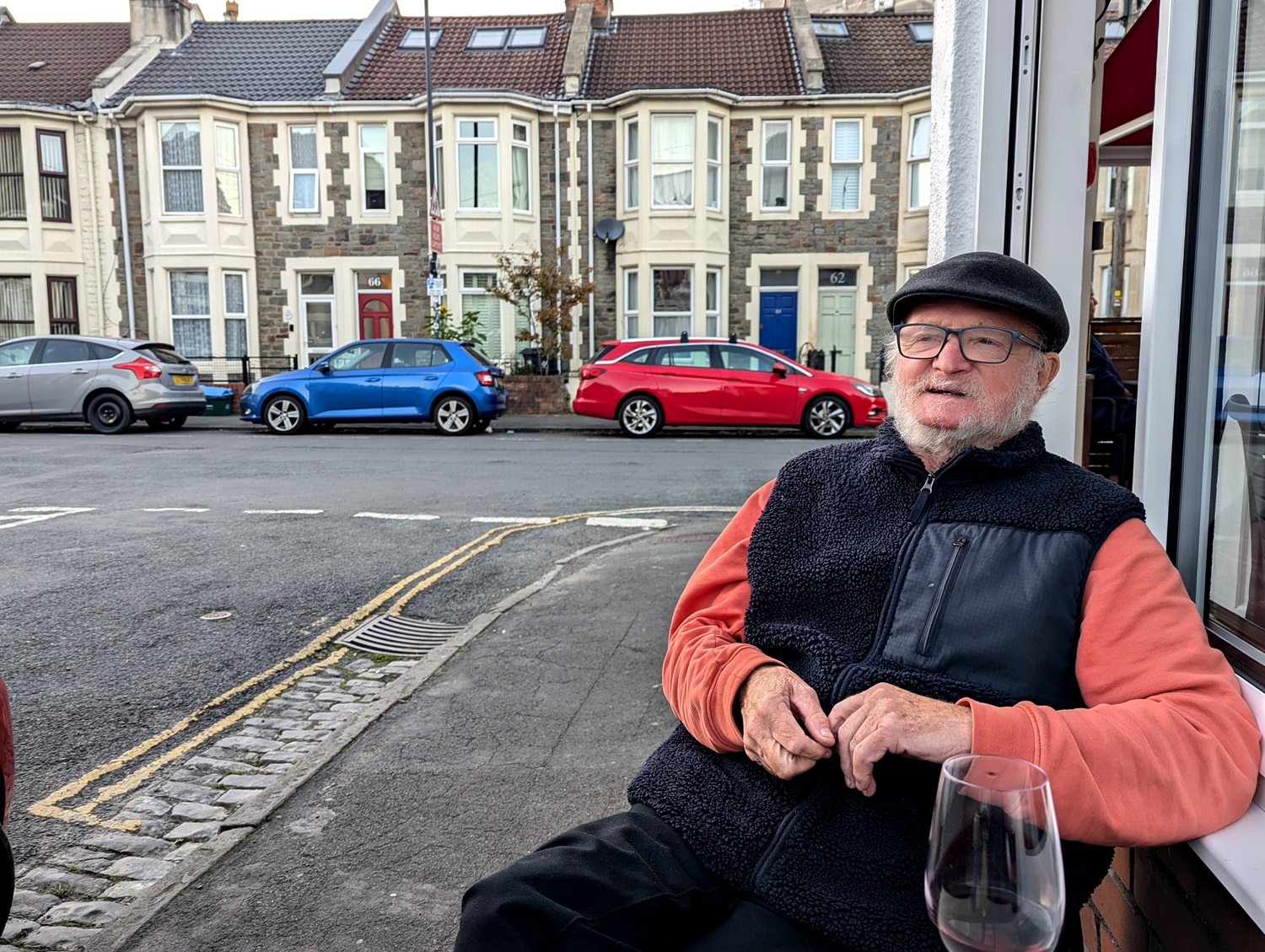
“Art has always been a part of my life…” Artist and Bristolian Terry Williams shares his experience of being a student at the RWA in the 60s and why art is something you can come back to again and again...
by Jamillah Knowles
Terry Williams is in good spirits as we sit in his kitchen on a sunny afternoon. He’s just said farewell to another visiting friend and as ever he is welcoming and cheerful as we start talking through topics for our interview.
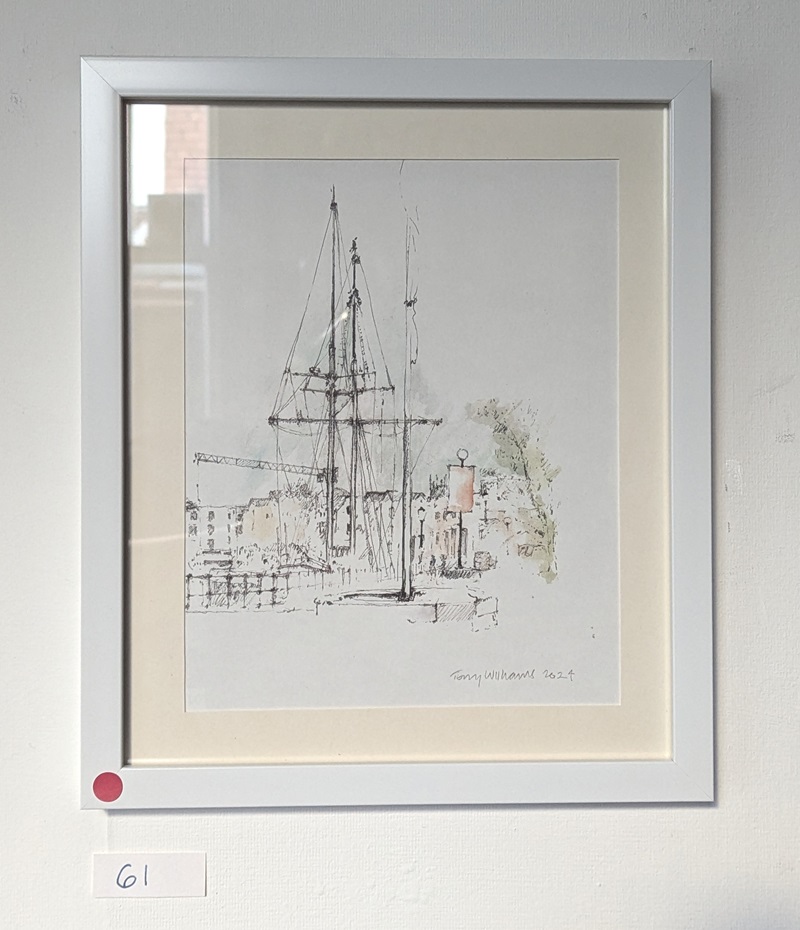
Terry’s known for his beautifully observed ink pen and wash drawings as well as his deep and moody oil stick landscapes. His prolific work is often found in the North Street Gallery and his home is a much anticipated stop on the South Bristol Arts Trail each year.
Terry’s career in art started early. In fact, he was to be found in the Saturday morning art school in the basement of the RWA from age nine to seventeen. “They would come around to the schools and anyone who could draw a bit was invited to the classes. It was good, but I was a bit annoyed because I would miss ABC Minors and Flash Gordon at the cinema.”
Terry’s father worked in the Post Office sorting centre and his mum was a housewife. “She was very good in school, but back in those days there were not as many opportunities for women,” he observes.
“They were supportive of me and my older brother,” he continues. “But I got polio when I was five and I was paralysed down my left hand side for a time and I’m left handed, so it was difficult. At that time I was sent lots of paper, pencils and crayons, which might seem like an odd thing to send to a child who has paralysis, but being able to draw became a kind of physiotherapy and helped with some of my recovery.”
As an emerging artist, Terry copied comics to learn the skills. “The best comics like the first two pages of the Eagle, drawn by Frank Hampson, were so magnificent that I thought I would never be able to do it.“
A different Bristol
Terry was growing up in a city that was still recovering from the war. “There were a lot of poor areas and places like Clifton were not so prosperous,” he recalls. “I remember someone bought three houses on Royal York Crescent for around £90,000.” Today one six bedroom house on this street costs around two and a half million pounds for the leasehold.
“The top of Jacob’s Wells Road was flattened,” he says. “It was just Buddleia and holes in the ground. I grew up in a Victorian tenement that was built in about 1850 or 60 for the ‘worthy poor’. I loved it there. We had no bathroom though, so we shared a tub and the last one in – usually me – came out grey on a Friday night,” he laughs.
“In Jacob’s Wells everyone helped each other out. Nobody locked their doors because nobody had anything worth nicking. You’d just walk in. I was in my Aunt’s flat once as a kid when I was about nine and the little girl from next door came in and ran around us with her mother chasing her and then back out again.”
While the community was strong, levels of poverty were high. “I saw some families taking stuff out of the pig bin – which was food waste – they were chewing on food from there because they were starving. I remember seeing our family doctor, Vicky Tyron, a wonderful woman, go into buildings with bags of food, bread and butter for people, anyone, whether they were her patients or not.”
RWA Study
Terry took his PreDip in art at the RWA from 1963-64 and recalls that time fondly. “I really liked the atmosphere,” he says. “Denis Curry and Neil Murison were particularly supportive and they were practising artists. I remember Denis used to make flying machines, he said he wanted to be Icarus, but I told him that he didn’t really, look at what happened to him.” Also teaching at that time were Leonard McComb and Paul Feiler who was the head of painting.
“We did a lot of experiments, it was a taster course in a way,” says Terry. “So you did painting, sculpture, etching, litho, fabrics – there was a lot to learn. Overall I give the place credit, they were interested in their students which is not always the case.”
From the RWA, Terry then went on to study at the Bath Academy, but this was not to be a match. “We didn’t get on,” he says. “I didn’t last long there. I did get to meet the saintly Michael Kidner – a wonderful tutor and human being. It was a big shock getting kicked out but I think it was the best thing that happened to me. You don’t know it at the time, but good things can come after you drop out of art school. So I took a year off and then went down to London to do the teacher training course at Goldsmiths’.”
“I loved it there. The teacher training art faculty was very good and very supportive, especially John Perry who was a practitioner and very interested in what people were doing. I left and then ended up teaching English for 25 years as a lot of art teachers do.”
Freshly armed with a teaching diploma, Terry returned to Bristol and took a job in the English department at Lawrence Weston. “I was going to stay for a term and I stayed much longer,” he says. The job turned into a teaching career which saw him working at the school and then in secure units and a youth detention centre until he took early retirement at 50 after teaching for seven years at King Edmund School in Yate.
Not sitting still, Terry taught abroad for two years in Uruguay and then another two years in Portugal. “Then I really called it a day and that’s when I started to take up painting again. It was thanks to someone in the neighbourhood who was helping to run the South Bristol Arts trail. They encouraged me to make something and I’ve been doing it now for over a decade.”
Drawing from life
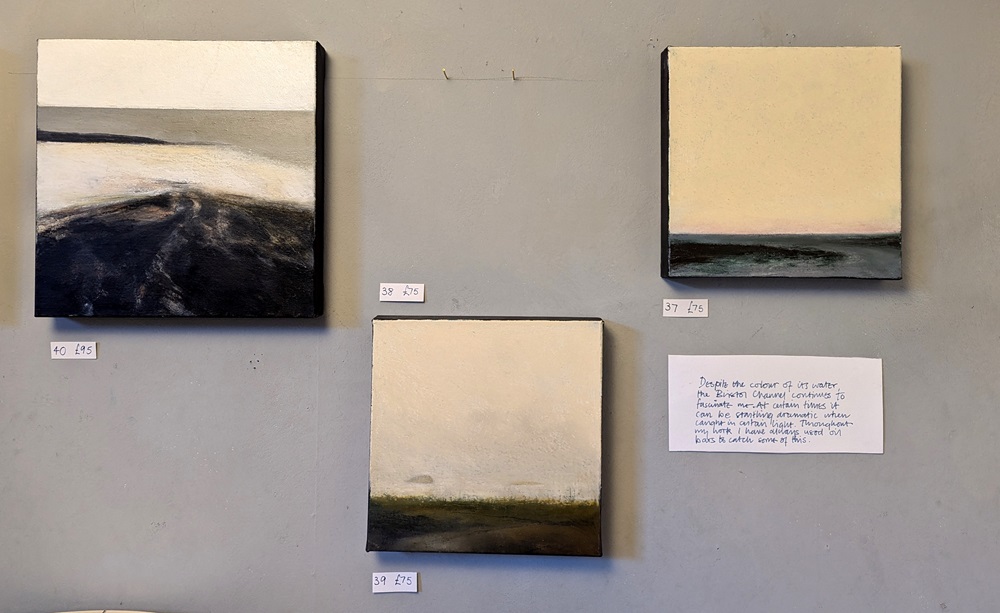
Now nearly 80, Terry is a prolific maker of work. Around the time of the Arts Trail he fills three rooms with pieces from sketches to large paintings. “About ten years ago, I discovered oil bars and they were a great influence on me. It’s oil painting without the painting bit. It’s glorified colouring in,” he says modestly. “Before that, I was using acrylics and I got fed up with the way they dry and I like to have more time to mess around. I can use turps and start again with oil.”
The results are beautiful tonal works that evoke the scenes around the Severn Estuary in assorted weather. The blended muted tones create a sense of depth and various moods depending on the days when Terry sketches or takes photographs on location.
The location studies of urban areas around Bristol are lively and well composed. Even the most regular day-to-day scene is closely observed and reflected. “The studies are my comfort.” Terry says, gesturing to a wall of works in his kitchen. “I know I can do it and people like them.”
Terry also makes some abstract pieces, using the muted tones that appear in the Estuary paintings. “I’ve always wanted to be an abstract painter, but abstract painting is hard to get right,” he notes. “That’s where I would like to work on a really large-scale piece. To get covered in paint,” he grins at the thought. “The painters that I like to emulate or I am inspired by are the abstract expressionists like Robert Rauschenberg or Richard Diebenkorn. “It would be lovely to work on a canvas as big as this room with a long and wide brush,” he says.
Given his lifelong experience of art and prolific methods of making beautiful images, it would be wise not to count out the idea that Terry Williams will achieve that large canvas and we may see it some day in North Street Gallery or on the Arts Trail.
Jamillah Knowles is a writer, artist, AI specialist and RWA Friend. You can read a Floating Circle Meet the Artist Q&A with her here.

 The Floating Circle