
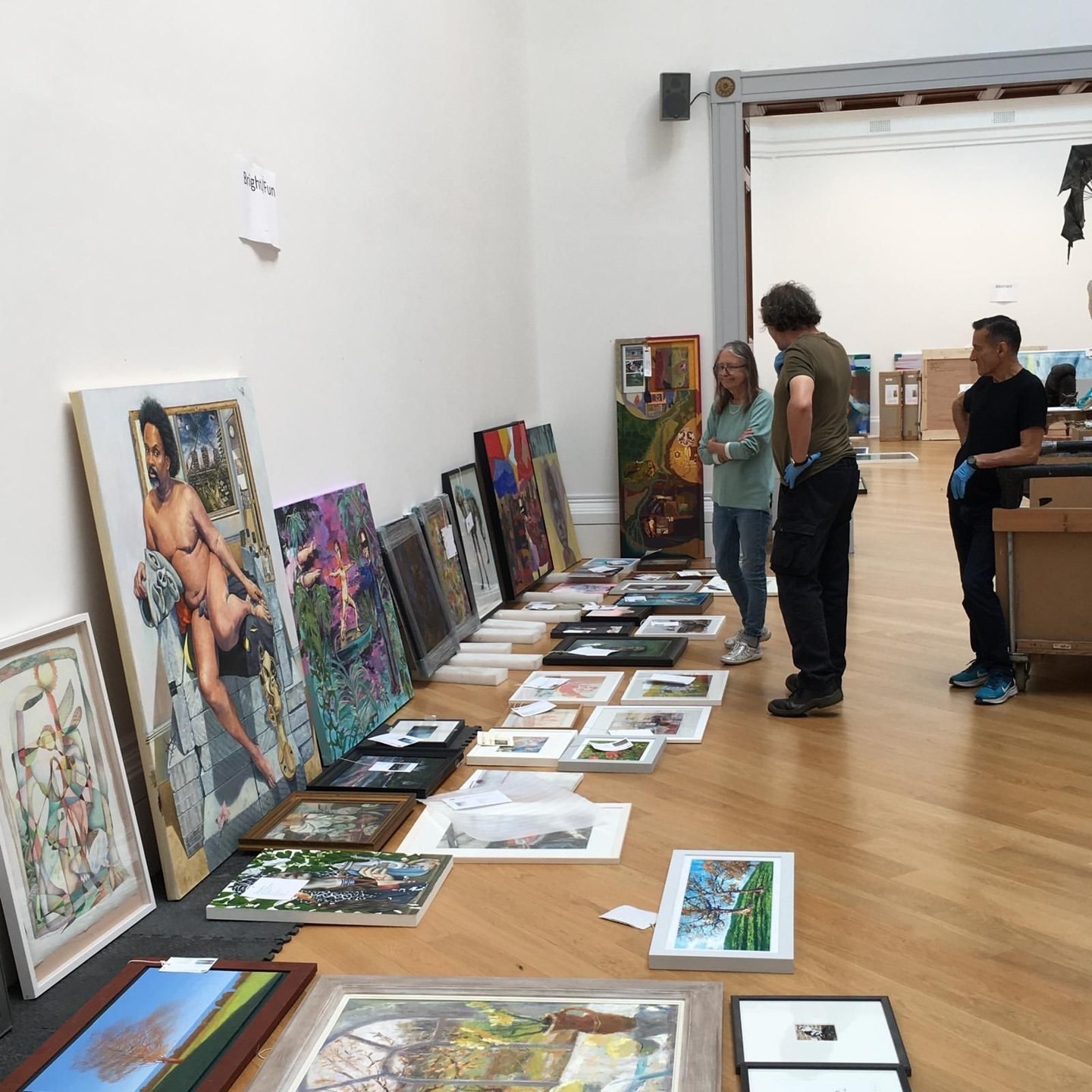
The joy of the annual RWA Open lies not just in the hundreds of individual artworks on show, but in the skilful, sensitive and often witty way they’re arranged. So how you do turn a huge, disparate array of works into a coherent exhibition?
This year the sculptor PATRICIA VOLK RWA FRSS joined President Fiona Robinson and her placing team to help with the 171 Open hang. Here Patricia shares her impressions of the experience…
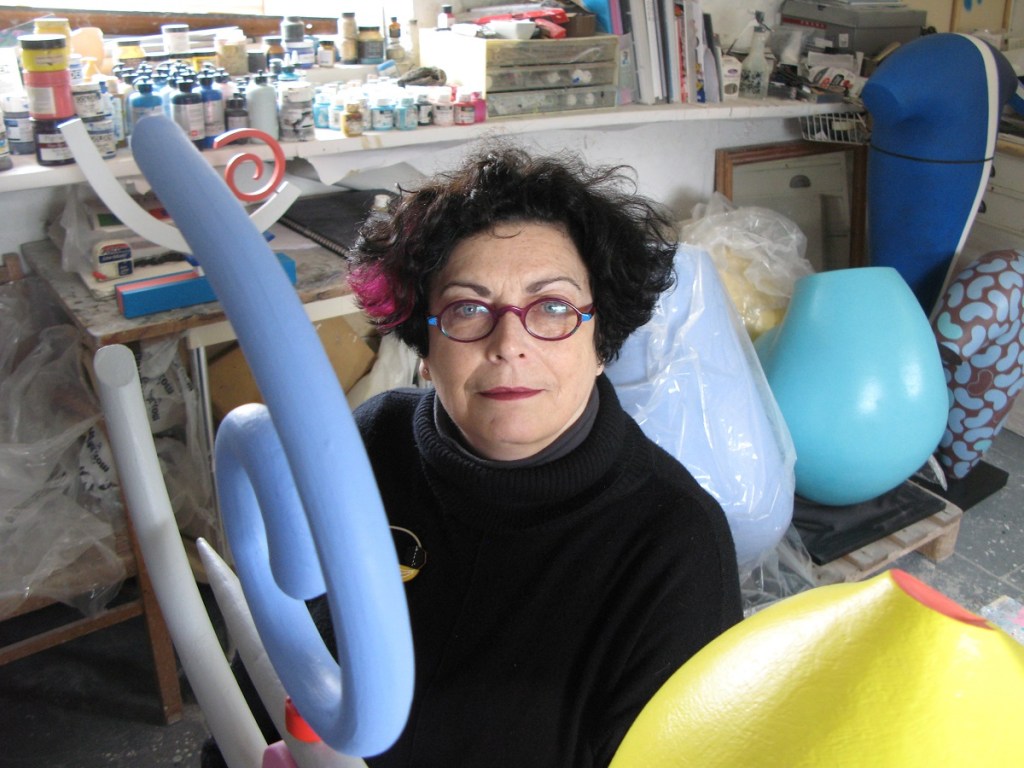
by Patricia Volk RWA FRSS
My first reaction on being asked to help hang was fear. Then, “Well, if Fiona [Robinson PRWA] thinks I can do it, I will!” I felt very privileged, if a little daunted, to be asked to make decisions on what is such an important RWA exhibition.
I did some research online for advice on the best way of going about it, so that I didn’t go in cold, but when I walked into the gallery, I was knocked for six at the enormity of the task and the amount of work to be displayed. What was clear from the outset, and a relief, was the energy of Fiona, who was very much in control.
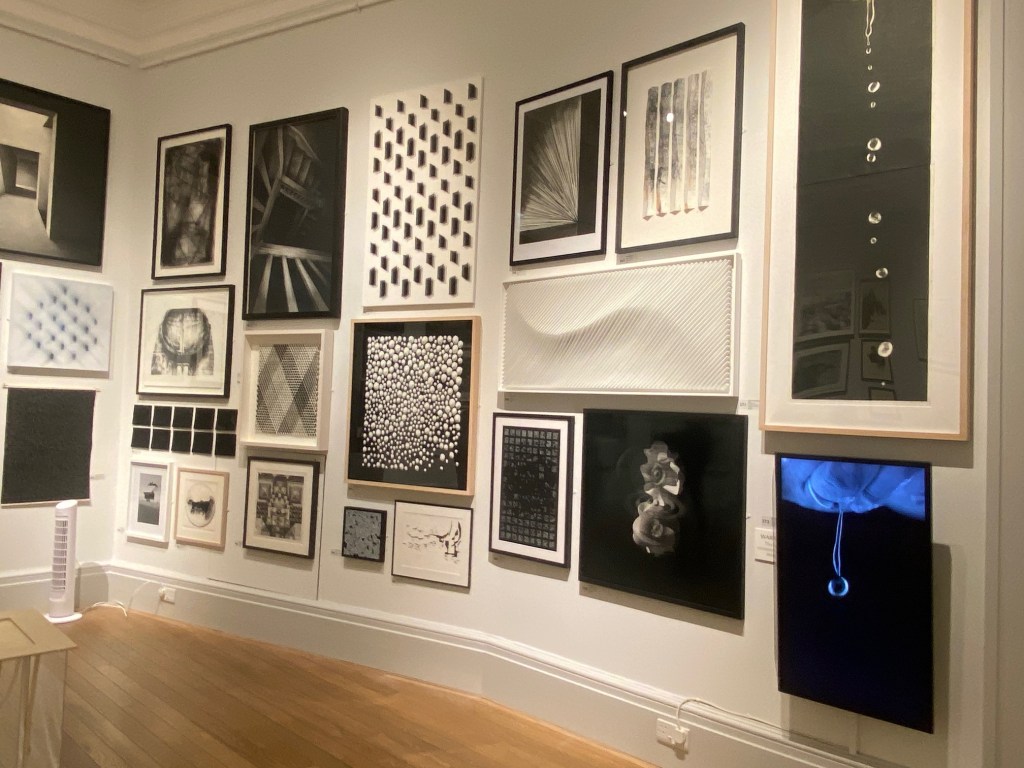
The Gallery had been divided into different ‘headings’; Black/White, Colour, Prints & Architecture, etc. Some space had already been allocated to invited artists, e.g. Rana Begum, and other larger artworks and video screens. Hamish Young RWA and I had been allocated the Black/White room that is at the back of the main gallery through the door on the right hand side.
The works had been loosely allocated to our Black/White section, but there was lots of room for interaction with Print, for example, and I think Ben had already done a lot of this for us in advance. I have to say, both Ben and Tristan are outstanding in their skill. I honestly thought: what would we do without them?
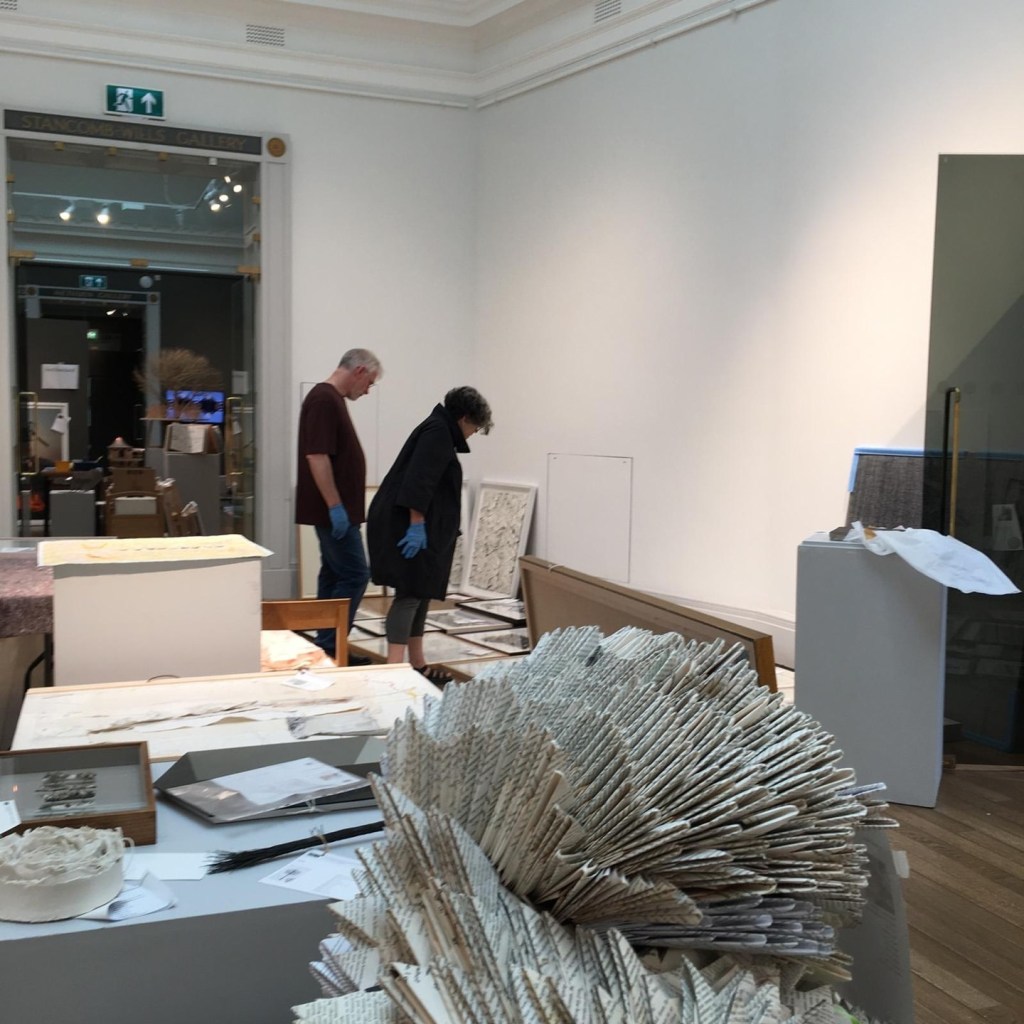
The first time Hamish and I worked together I think we regarded each other a bit warily, wondering: “Is this going to work out? Are we going to get along, or will one of us be bossed around?” Quite silly worries looking back on it, but understandable.
We began by dividing the works by subject matter – abstract, figurative, pieces that visually complemented each other, and so on. One of the problems with the room is that two of the walls opposite each other are not straight, there is a bend in each of them, so in fact it makes them each two walls.
We arranged the larger artworks to lean against the walls, then, below them, on the floor, arranged others as they will eventually appear on the walls. Of course, wearing gloves the whole time.
It was important to think of the hang as one large space, almost like a large painting. As an artist, when you walk into a gallery, you are looking for your own wor (the most important thing in the room!). However, to hang, we had to think of the whole effect. Sometimes works might clash with and diminish each other, then again, selected and arranged properly, they would sing, really complementing and enhancing each other. Hamish and I would often ask ourselves: “Would we be happy if this was our work?” That was the crucial question, really.
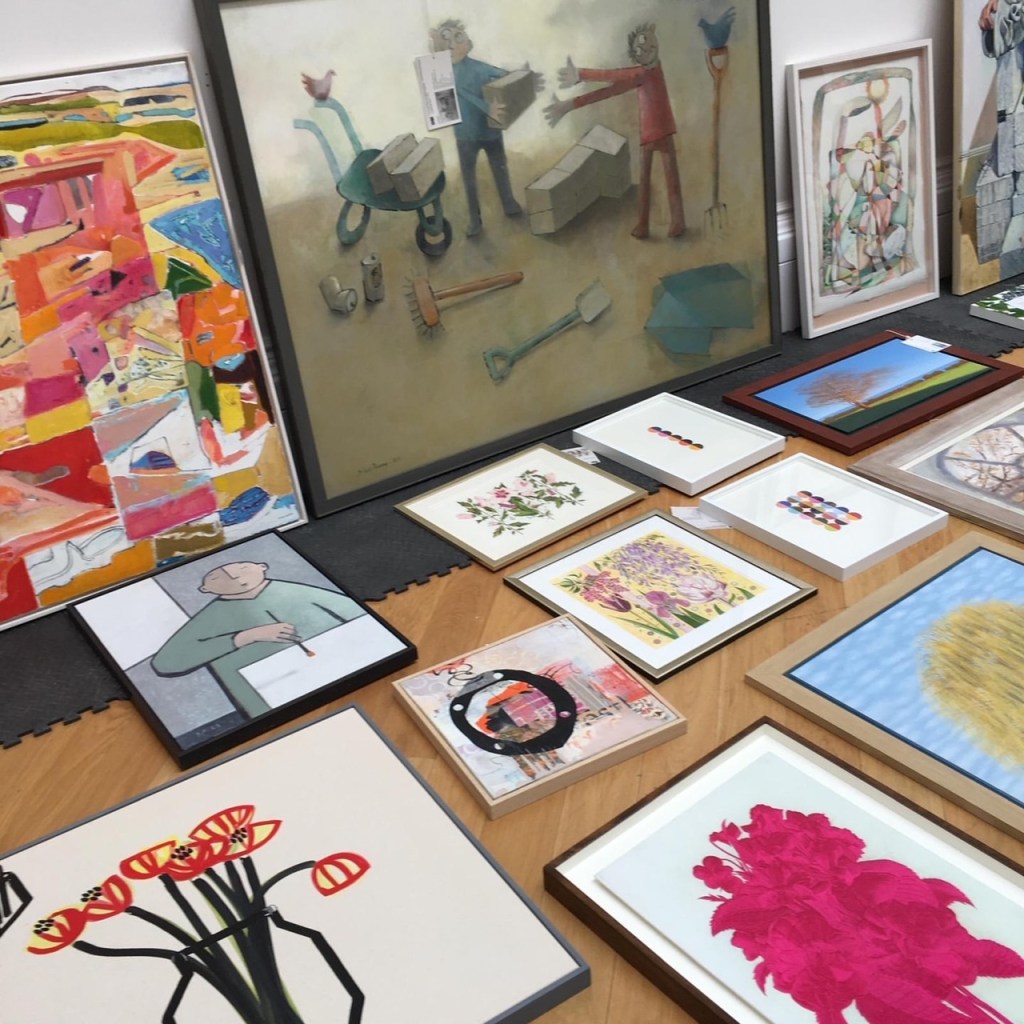
I found it interesting that, when we lifted the work, we could feel the integrity, and were well aware of the preciousness of the objects being entrusted to us. In my own practice, I am inclined to rush things and be a little hyperactive. I could not do that here as it was important to be as careful as possible.
The first day we probably altered the arrangement three to four times, if not more, constantly changing our minds. Sometimes the frames would be distracting and a rethink would be needed. It is a rather intense process, so it is important that we were both on the same wavelength. Which, luckily we were. We would walk around every so often to see how the others hanging the other sections were doing and we’d be on the lookout for any pieces that might be better served by adding them to our displays – though I’d almost call them ”compositions” as they evolved organically into something that felt the items all belonged together in a satisfying way.
We worked from 9.00 a.m. until 5.00 p.m. on the Tuesday, taking lunch together downstairs for a chat. This was so refreshing for me as, working alone in my workshop most of the time, it was a joy just to have a light little chat with brilliant company. The whole atmosphere – though it was hard work – was very uplifting and, in fact, inspiring. I was delighted it broke me out of my solitary routine and gave me a much-needed buck up.
Of course, after deciding the night before that everything was done, with the benefit of a fresh eye, the next day we changed everything around!
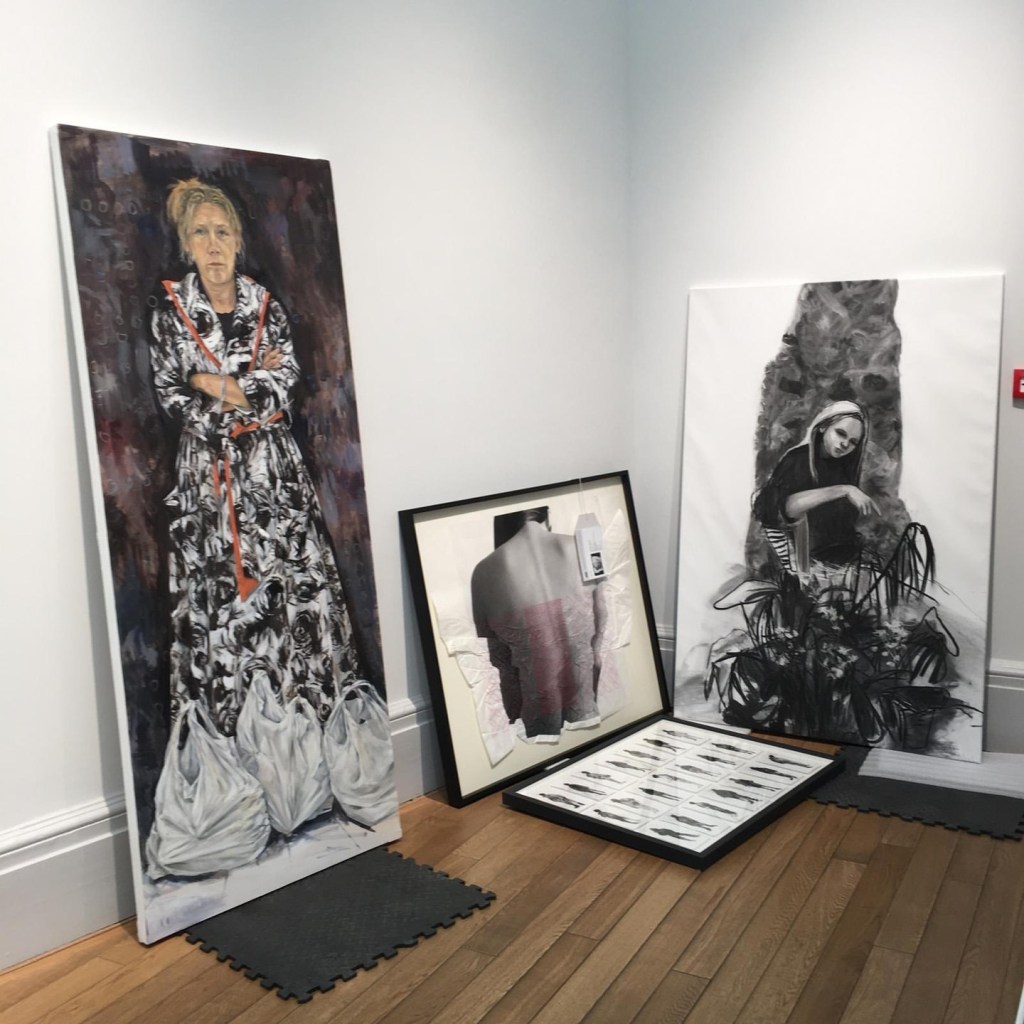
After a couple of days arranging how the artworks will be hung on the walls, it is the turn of the Sculpture placing by Ben Rowe RWA, Tom Waugh RWA, and Hamish Young RWA. They do such a good job and it is a joy to see sculpture displayed properly with attention to what is on the walls.
We did two days just arranging our room, as did the other six people on the placing team. The first week was spent arranging where the works would go, then probably a week doing the actual physical hanging at least, then there is the labelling and the catalogue: a massive task!
I can confidently predict it’s an outstanding Open show. Something for everyone. People will say, as ever, it’s the best yet, but they say that because it is fresh and new and the artworks have never been seen before in this location! It will be a perfect opportunity to see and be inspired, and something Bristol should be well proud of.
Placing Team: Fiona Robinson PRWA, Andrew Hardwick RWA, Professor Stephen Hoskins RWA, Charlotte Price RWA, Patricia Volk RWA, Hamish Young RWA, Stephen Jacobson RWA, Mike Richards RWA
Kenny Gallery: Stephen Jacobson RWA. Malcolm Ashman RWA
Hanging team: Led by Ben Rowe RWA Tristan Pollard With assistance from technicians and volunteers
Read our Meeet the Artist interview with Patricia here and see more of her work at www.patriciavolk.org
The RWA 171 Open runs from 14 September 2024 – 5 January 2025, and Friends have unlimited free entry. More info is here.

 The Floating Circle
1 Comment