
Rob Campbell on the magic of mysterious portraiture…
By Rob Campbell
If you want to sell paintings, then, according to most league tables about sales, and to most artists I’ve met, you’d best make landscapes.
After that the top sellers are abstract landscapes, and not far behind that are portraits of other people’s dogs. Lagging behind those, in terms of what people buy, are paintings of human beings.
That seems odd, given that the most viewed painting in the world is the Mona Lisa, and the most digitally viewed painting in the National Gallery is the Arnolfini Portrait.
It was, therefore, something of an adventure when my home welcomed its first ever ‘proper’ portrait a few weeks ago. But it has been a joy.
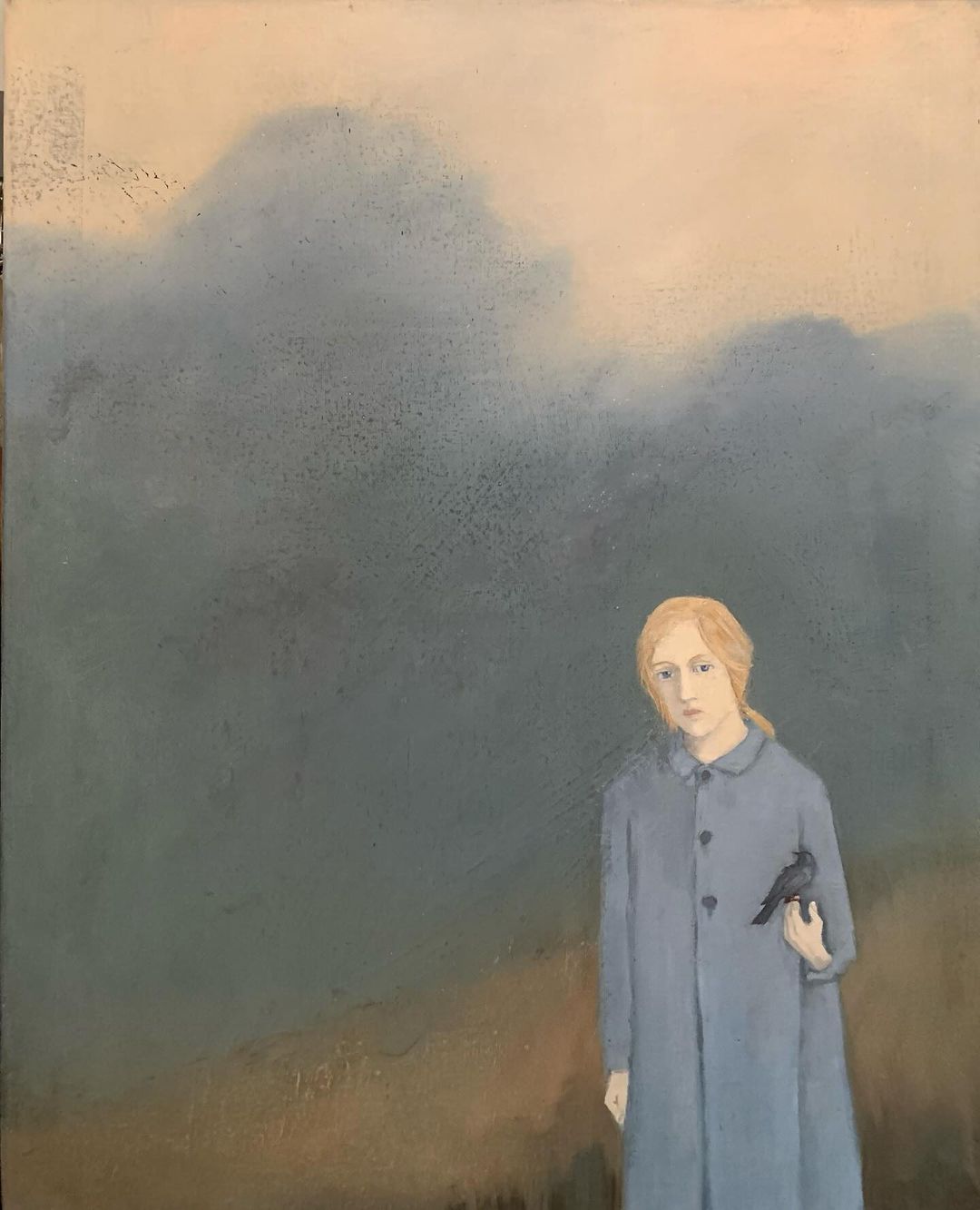
The painting is of a plainly-dressed young woman standing on a hillside, peering into the middle distance, with a black bird resting on her left hand.
We don’t know anything about the woman, and neither does the painter, because the image was inspired by a found photograph of a stranger.
Our new house guest is unknowable, so we make up stories about her. She is, depending on our own moods, sometimes pensive and sometimes just exercising her right to pause. She is one day lonely, and the next just enjoying some ‘me time.’ She’s looking for the secret of life itself, or simply a friend who’s coming up the hill out of our view. She is mostly intriguing, but sometimes irritating in the way she holds her secrets so close.
The woman with the bird has made us into story-tellers, and I have even asked of her the questions favoured by teachers of creative writing, who use portraits as prompts for character development. Who does the woman with the bird love, and who loves her? What’s her most treasured possession? What’s her morning routine? And so on, until you reach the big one that drives any plot: what does she want, why can’t she get it, and what’s she going to do about that?
There’s even a recent novel doing just that – building stories around those who have been painted, but who remain in the shadows. It’s The Flames, by Sophie Haydock (who also judges the Bath Short Story Prize this year), and it brings to life the extraordinary stories of four women who posed for the controversial Austrian artist Egon Schiele.
Some of the most compelling portraits are often of those whose stories have been less often told. Such as that of RWA founder Ellen Sharples, who was according to one writer ‘painted out of history’ but is there for us all to know in her portrait and the narrative around it. Or the self-portraits of Big Jeff at the Beacon last year, calling us to look at the person beyond the disability.
Or the story of the Windrush generation, so powerfully told in a series of ten portraits commissioned by King Charles, and coming to the RWA in May 2024. These images tell us a lot about those they portray, and about the world we live in, but, like the best portraits (even of strange women holding birds) they compel us, above all, to keep on asking questions.
Image: Girl With Bird by Jane Bennett
Rob Campbell is a freelance writer and editor. View his website here.

 The Floating Circle