
Rob Campell finds a Bristol connection in a notorious royal funeral…
By Rob Campbell
In these turbulent times it is useful to be reminded of the importance of keeping our heads – and letting other people keep theirs.
One such recent prompt came to me in the form of an Instagram post just before Christmas by Christopher Spencer, better known on social media as Cold War Steve.
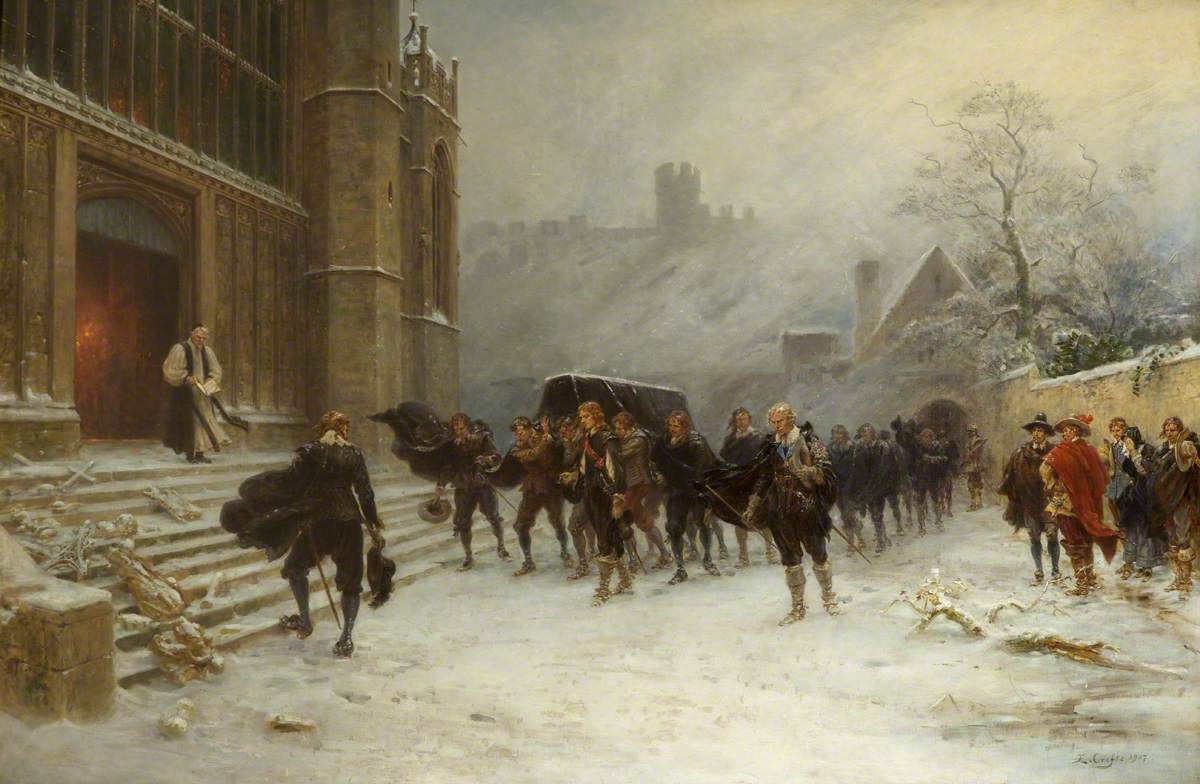
It’s a piece of political satire that brings us very close to home – just down the road from the RWA itself. Spencer has adapted a painting by Ernest Crofts called the Funeral of Charles I, St George’s Chapel, Windsor, 1649 (top).
The work, painted in 1911, is held in the Bristol Museum and Art Gallery. It shows noblemen taking the body of their recently executed king to the chapel. They are bent to the wind as they bear, through the snow, a coffin beneath what appears to be a plain drape. Ecclesiastical debris is scattered by the steps of the chapel, but there is a hint of warmth and light from within. The Bishop of London awaits, but Windsor Castle’s governor insists there will be a burial only, with no ceremony.
Historical records suggest that the late King’s noble friends wandered about looking for a suitably empty vault for their monarch before he was eventually interred, accompanied only by silent tears, and the vault promptly bricked up.
In Cold War Steve’s contemporary rendition, the coffin is draped with an NHS banner. One of today’s most hallowed institutions is to be dispatched, without any fuss, by recognisable members of current and recent governments and their friends.
Both images speak of desperation, indignity, outrage, humiliation and the upturning of things that we thought were secure. Spencer’s image leaves no doubt as to who he thinks is to blame. The original is more ambiguous, with Crofts seeming to emphasise the sheer tragedy of the event, and leaving space for one’s own views about how 17th century England arrived at it.
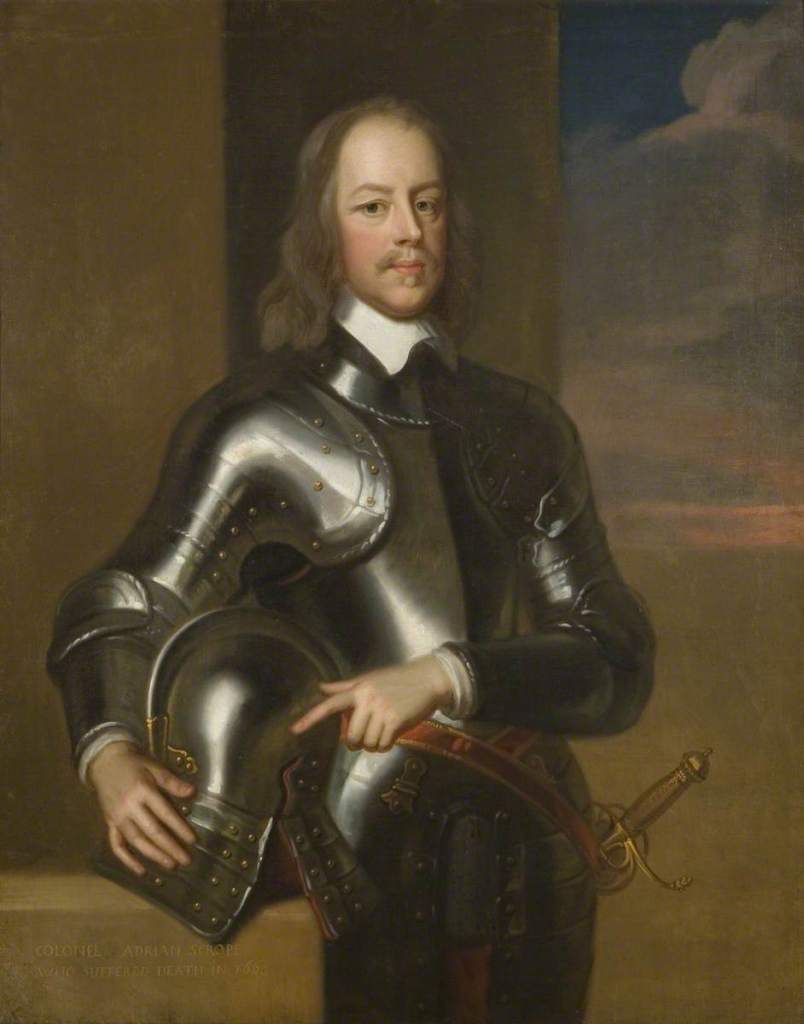
There is, incidentally, a painting in Bristol of one of the men who signed the death warrant of Charles I. He was Colonel Adrian Scrope, and his portrait by Robert Walker is in the Red Lodge Museum. Scrope himself was executed in 1660, after the restoration, for regicide.
Crofts’ funeral painting work was donated by Sir William Henry Wills (Lord Winterstoke from 1906), who helped establish the museum and gallery itself in 1905. The RWA was already there by then, a short walk away, thanks largely to pioneering woman artist Ellen Sharples. She persuaded, amongst others, a member of royalty (Albert, Prince Consort) to part with nothing more painful than money to help get things started.
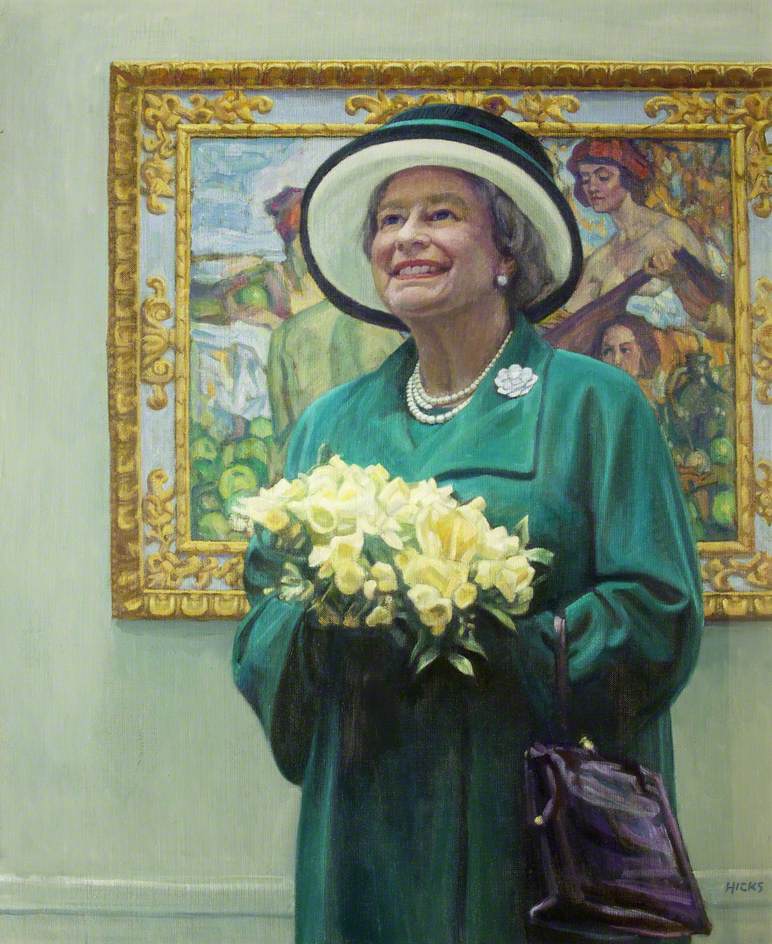
In 1913 King George V granted the RWA its Royal title, with the reigning monarch to be its patron thereafter, and in the academy’s collection there is to be found a delightful painting of the RWA’s most recent patron, who kept her head and had a rather better funeral than Charles 1.The oil on canvas work, by Jerry Hicks, is called simply Her Majesty The Queen at the Royal West of England Academy.
Rob Campbell is a freelance writer and editor. View his website here.
Image top: Funeral of Charles I, St George’s Chapel, Windsor, 1649. Ernest Crofts (1847–1911)
Bristol Museum & Art Gallery

 The Floating Circle