

We chat to Sam Dowling, winner of the The Floating Circle Prize at the RWA 170 Open…
“…I was at the point of dropping my 3-D Design A-Level…But, one day I noticed a potter’s wheel sitting untouched in the corner of a classroom. I remember the day clearly, as I decided almost instantaneously that I wanted to learn how to throw..”.
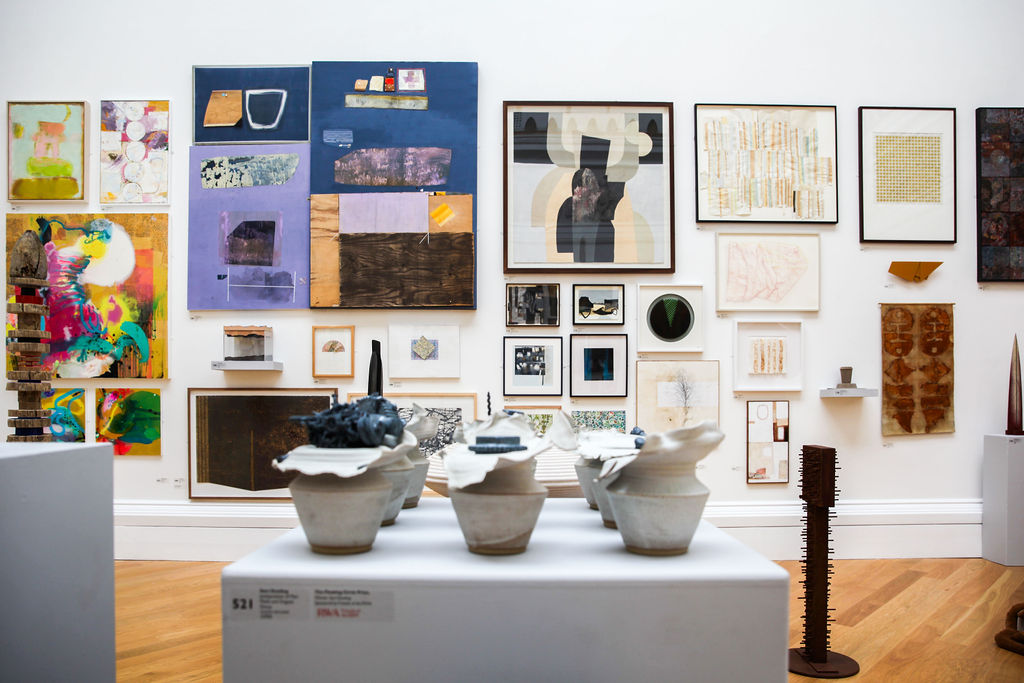
Sam Dowling was the winner of The Floating Circle Prize at the RWA 170 Open. His sculptural work Juxtaposition of Man-Made and Organic Decay combines ceramic and metal objects to striking effect, impressing the Academician judges and winning the prize amid very strong competition. We invited Sam to tell us a little more about the work and his fledgling art career…

Congratulations on winning the RWA 170 Open ‘Floating Circle’ prize for your work Juxtaposition of Man-Made and Organic Decay. What does winning the prize – selected by a panel of Academicians – mean to you?
I’m honoured and truly grateful to have been selected as the winner for the Floating Circle Student Prize. I never imagined any of this happening whilst I was creating the piece, so this is far beyond any expectations I had!
Being interviewed for the Floating Circle is something I have never experienced before, so I am thankful for it – as well as the £250 cash prize, which has gone straight into my ceramic fund account for me to use post-degree.
Tell us about the background to the work – when did you make it and how did you come to enter the piece for the Open?
Juxtaposition of Man-made and Organic Decay was made in the early months of 2022. To many people’s surprise, this work was actually my final piece for my Fine Art A-Level, which I studied at Cirencester College. The work and that period of my education hold many special memories (as well as a lot of coursework!) – I’m so pleased to share a glimpse of it with the public.
This past year I’ve been studying an Art & Design Level 3 Diploma next door to the RWA at the Bristol School of Art. It was about this same period last Autumn that I remember visiting the 169 Open exhibition and being heavily inspired by the countless works of art on display. The idea of showcasing my ceramics in the RWA gallery alongside 600 other practising artists was an opportunity I couldn’t resist. And well, here we are!
As the title suggests, the work juxtaposes ceramic and metal materials in a state of decay – making for a striking textural effect. Can you say a little about your thinking behind the piece and what you’re trying to explore or achieve?
I am visually drawn to contrasting textures, processes and aesthetics, and when combined against their supposed ‘opposite’ I think their individual tactile and visual appearances are enhanced. This style of creative practice makes for very interesting and striking pieces of artwork/design.
Like the title suggests, ‘Juxtaposition of Man-Made and Organic Decay’ was developed through an investigation of different types of decay, both natural and man-made. I began by searching for inspiration surrounding man-made decay by visiting and exploring abandoned buildings and locations. To name a few… Hunting Butts train graveyard (near Cheltenham), Talgarth Mental Asylum (Brecon Beacons), Fairleigh Down Tunnel (BathEaston) and a scrapyard near Old Sodbury, which is in fact where I collected the metal items that sit within the vessels.
The ceramic vessels which uphold the metal tools are a stark contrast in their own right. Thrown in one piece, they each display an impression of both man-made and organic decay. The refined angular bases suggest the intervention of man, whereas the upper half takes on a much more wild and unprocessed character.
When did you realise you were an artist?
Art has always had a presence in my life; my education until I was seventeen took place at a Rudolf Steiner school – an alternative form of education, taught through natural development, play and creativity.
When I was twelve, I remember beginning to take a great interest in my artistic education. I have always been lucky with my tutors, to whom I owe a lot of inspiration and motivation. Being able to maintain a healthy working relationship with these tutors throughout my GCSEs and A levels – indeed to this day – has definitely helped me realise that creating art is what I love pouring my time and energy into.
How did you get into ceramics? Is it true that you were initially self-taught?
Well, whilst I was studying my 3D Design A-Level I found it very challenging to find a process within the subject that I wanted to explore and really get competent at – architecture wasn’t for me.
Over half-way through my first year I still had no idea what to do and was beginning to get very far behind my peers. I was at the point of dropping the subject. But, one day I noticed a potter’s wheel sitting untouched in the corner of a classroom. I remember the day clearly, as I decided almost instantaneously that I wanted to learn how to throw.
I learnt the key processes of the craft from our college technician and then I was away, spending hours and hours of my own time practising in between lessons. When we came back in our second year, I used YouTube tutorials and rode the (ceramic) wave I had caught!
We understand you’re about to study ceramics at university. What are your plans for developing your artistic career?
I have just begun studying Ceramics at Cardiff Metropolitan’s School of Art & Design. The content delivered thus far has been excellent and the tutors are extremely friendly and approachable. I’ve entered the course with an open mind and have no intentions of closing any artistic doors that may open. All I need to think about right now is that I have three years to experiment, explore and develop my practice, with an aim to develop my contextual and practical understanding within the world of ceramics. I am so excited to see where I end up by 2026.

Finally, a fairy godmother waves her magic wand and says you can own any artwork in the world. What do you choose?
Anselm Kiefer’s ‘Shevirat Ha-Kelim’, a huge installation that depicts sacred broken vessels falling from the gods and cascading down a great pyramid onto the gallery floor. The textures, earthy tones and three-dimensional aspects are truly something to behold.
Follow Sam on Instagram @samdceramics. He can also be contacted via samdowlingceramics@gmail.com
The RWA 170 Open continues until 14 January 2024.

 The Floating Circle